

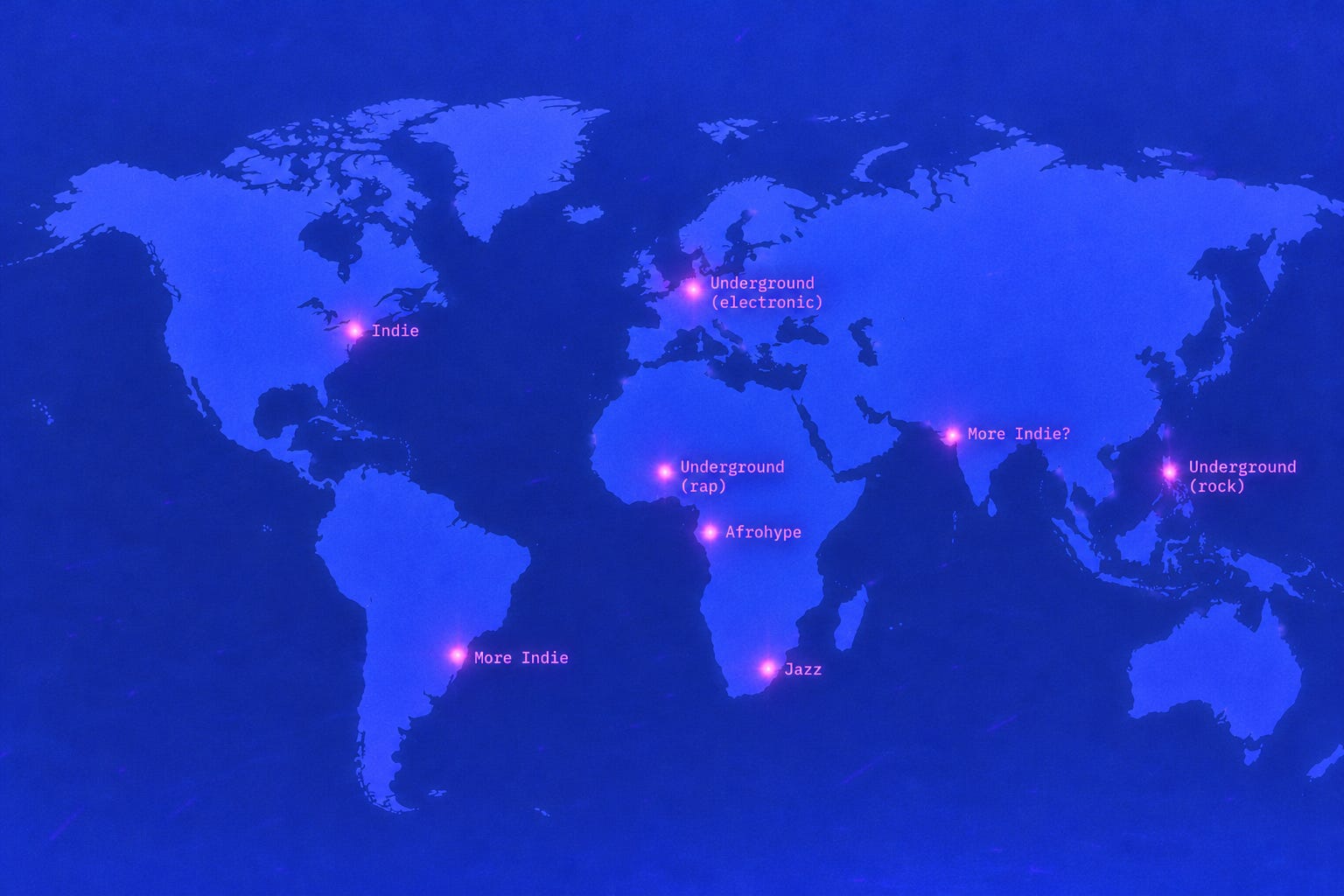
What exactly is the “underground.” That word, as well as related terms like “indie” and “DIY,” gets thrown around frequently in articles with an assumption that the reader already knows what it is. But while it’s probably true that most readers have an idea of what constitutes the underground, it’s not clear their ideas are always the same. In the U.S., the word has a strong association with the Our Band Could Be Your Life rock groups from the ‘80s, meaning “underground” often evokes a guitar-oriented sound à la Fugazi or Hüsker Dü. This association doesn’t really translate to the Nigerian underground, which skews more towards hip hop than alternative rock.
Even when “underground” and “indie” are given strict definitions along the lines of “a music scene that’s independent or separated from the mainstream,” geographic differences can still quickly rip any sense of shared understanding apart. Independent of what, exactly? In India, for example, music is “mainstreamed” less by major labels and more by Bollywood soundtracks, which means that any artist operating outside of Bollywood are often classified as “indie” — including pop artists that would rarely attract that designation elsewhere. For people who connect “underground” and “indie” scenes with a certain style or aesthetic (which, I’m willing to bet, is most people), these connections often don’t translate across national borders.
And then there’s the questions of whether reporting on these scenes truly offers the full picture. Most of the articles this month are about underground scenes in one way or another, but for whatever reason, “indie” and “underground” scenes covered in Bandcamp Daily look more like what many Western indie heads might expect, while those covered in The Fader or Rolling Stone tend to take on more regional characteristics. Is this because The Fader and Rolling Stone are unconsciously filtering their selections based on what they expect artists from Africa or India to sound like? Or are Bandcamp writers finding styles similar to what they’d hear in Western indie scenes because that’s what they’re used to looking for?
Maybe both accounts are accurate, but unreliable or incomplete narratives are a constant concern when reading (or writing) about music scenes. The artist Kilo Kish sums it up well in the Pigeon’s and Planes article featured below: “It just all comes down to who’s telling the story, and who is writing the history or rewriting the history.” These question that’s been spinning in my head more than usual lately as I’ve been entering the chat myself with an article on Oakland’s underground dance scene (which should be published next month). I feel like there’s a a longer essay buried somewhere underneath these questions, but that’s for another time. For now, I’ll pull a Nathan Fielder and let you judge for yourself.
The Album
Ino Guridi, Pasará (Uruguay): Patient, introspective bedroom pop brimming with yearning and mystery.
The Report
Africa: The Guardian’s Eromo Egbejule introduces readers to Afrohype, an Afrobeats subgenre characterized by hypemen (and occasionally hypewomen) that get crowds moving with a mixture of singing and rapping focused on high-energy quips and ad-libbed lyrics. The style has a long history across western and central Africa, rooted in call-and-response vocal styles that have been popular for centuries. In West Africa this was the domain of griots, while in the Congo it manifested in a style called atalaku. Today, Afrohype (also called lamba) is a full-time career, with practitioners like Toby Shang pulling down large sums to perform at parties, weddings and corporate events. Cote D’Ivoire even ran an atalaku talent show that was won by female Afrohype artist Lili Djely.
Uruguay: It’s been four months since this newsletter featured something by Richard Villegas, which is a pretty long absence for one of the most prolific archivists of contemporary Latin American music. This month, Villegas returned to Bandcamp with a piece on Uruguay’s indie scene, which is as varied as the genre tag implies. Electro-pop, freak folk, and heartrending alt-rock all make appearances in Villegas’ characteristically long list of music recs. Sandwiched between Argentina and Brazil, Villegas argues that Uruguay has long punched above its weight, making major contributions in tango and candombe, a form of drumming endemic to Uruguay’s Afro-diasporic community that was traditionally played on wine casks before evolving into the rhythmic foundation for much of the country’s folk music. Following the end of Uruguay’s military dictatorship in the mid-80s, rock en español became extremely popular, laying the groundwork for the lively indie scene it has today.
India: Compared to Uruguay, the Indian indie scene is a topsy-turvy place. In Western countries, where massive music labels provide the primary route to mainstream success, “indie” artists have traditionally been defined by their positioning outside “the majors.” This is different in India, where the hegemonic influence of Bollywood has made film soundtracks the main way musicians make it big. Artists in India are more focused on getting songs on the score for a major motion picture than signing to UMG, and as a result, Indian “indie” simply means artists that are making it work outside the movie industry. This was a bit confusing for me as I saw the word “indie” used to describe Indian artists that sounded and operated nothing like they do in the US, where “indie” has come to mean a specific sound as much as a business model. Indie artists in India rarely sound like the scuzzy Pavement look-alikes that attract the term in the West; they can be rappers, folk-fusion singers, or even just straight-ahead pop artists that have become famous through Youtube rather than Bollywood. Anurag Tagat does a good job explaining this in his profile of three such artists for Rolling Stone India, lifting the veil for Western readers once and for all.
Philippines: There’s nothing wrong with scuzzy Pavement look-alikes, though, and if that’s what you’re looking for, KEXP editor Dusty Henry has you covered. His walk through the Manilan underground, published this month in Bandcamp Daily, has all of the refreshing eclecticism one would expect from a true underground music scene. The trip is guided by Diego Mapa, a longstanding fixture of the Filipino capital who’s played in a plethora of scene-defining bands while also creating local classics through his solo project Eggboy. Maybe more notable, the piece establishes the Philippines as a true musical triple threat. The country is already getting attention for both its fast-growing pop scene and impactful homegrown dance music genre. The fact that it also has a robust underground community is another indicator of the country’s still-understated role as an artistic powerhouse.
Nigeria: Speaking of the underground, the Nigerian underground is once again getting some attention in Western media. After the rise and fall of coverage on the country’s alté scene, a new crop of artists operating outside the mainstream has been getting attention in Africa-focused publications, and now The Fader has tapped Wale Oloworekende to cover the ten Nigerian underground artists that are “shaping the scene” right now. There are some great names here, from subversive R&B artist Danpapa GTA (who’s been featured on past No Chambers playlists) to the Atlanta-esque trap savante scottyolorin (who, ironically, I first heard on Spotify’s “Alté Cruise” playlist). Overall, Oloworekende paints a picture of an underground that’s quite different from what Henry found in the Philippines, more focused on hip hop and Afrobeats influences that presumably loom larger in Lagos than in Manila. (For anyone that needs’ a refresher on the different genres kicking around Africa, Rolling Stone has published a nice primer)
Belgium: Moving through the synonyms, Bella Aquilina covered the DIY rave scene in Brussels for Resident Advisor. In her words, the oft-overlooked Western European city has all the foundational elements to kindle a killer dance community: a deep love of club culture, a central location (relative to Europe), a hugely creative population, and a surfeit of empty buildings for parties. It’s relatively easy, it seems, to put together a one-off event in Brussels; the challenge comes when Brusselaar partiers want to find a permanent home. Aquilina documents the byzantine noise regulations and other Eurocratic rules that Brussels clubs face through the story of one would-be club that, after its owners sank over a year and thirty thousand euros into it, was ultimately denied a permit. It’s an unfortunate story that holds a lens up to another feature of underground music’s friction with the mainstream, told by a talented writer and a publication that provides plenty of space for the details to breathe.
US: Rounding out this comparative analysis of indie/underground scenes, we’re turning back to the U.S., where Precious Fondren published a fascinating and vital reflection in Pigeons and Planes on how the re-mainstreaming of “indie sleaze” has written out the many Black artists that were integral to that scene in the first place. Contemporary recollection of the mid-2000s indie scene has condensed it into images of tight pants, messy eyeliner, and other aesthetic tropes attached to (mostly) white bodies. Fondren’s piece challenges and corrects this narrative by revealing how racially and sonically diverse that musical moment really was, as remembered by Black practitioners like Spank Rock, Kilo Kish, and Santigold.1 Even back then, many of these artists had a hard time finding a place in the narrative, with record executives often trying to shoehorn them into an “R&B” category that was far too narrow to contain the multifaceted music they were making. Today, they’re facing the challenge anew as selective memory whitewashes modern reinterpretations of that period and the people who participated in it.
South Africa: OkayAfrica’s Tšeliso Monaheng explores similar themes in an article on South African jazz, which interrogates how the country’s jazz scene has historically been co-opted by the apartheid’s anti-Black ruling class and, more recently, corporate interests. Originally nurtured in working class neighborhoods like Sophiatown and District Six, South African jazz gradually morphed into a more complex practice in order to push back against white narratives that Black communities couldn’t make “sophisticated” music. A desire for white validation thus became a component of the music’s evolution, undermining its potency as a liberatory movement. Monaheng highlights a number of contemporary jazz artists that are trying to subvert this legacy but also notes how echoes of it exist in the modern jazz scene, whose financial existence is increasingly attached to commercial partnerships with brands, banks, and other institutions that continue to profit from inequality in South Africa.
Bonus: If you want even more longform writing about the global underground, Toma Verlaine has been busy lately excavating the histories of DIY rock movements in Shanghai and Beijing. And while it’s not a scene report, I had an article published in Bandcamp last month on the Korean alt-pop band LEENALCHI, who definitely fit somewhere within the indie universe.
