

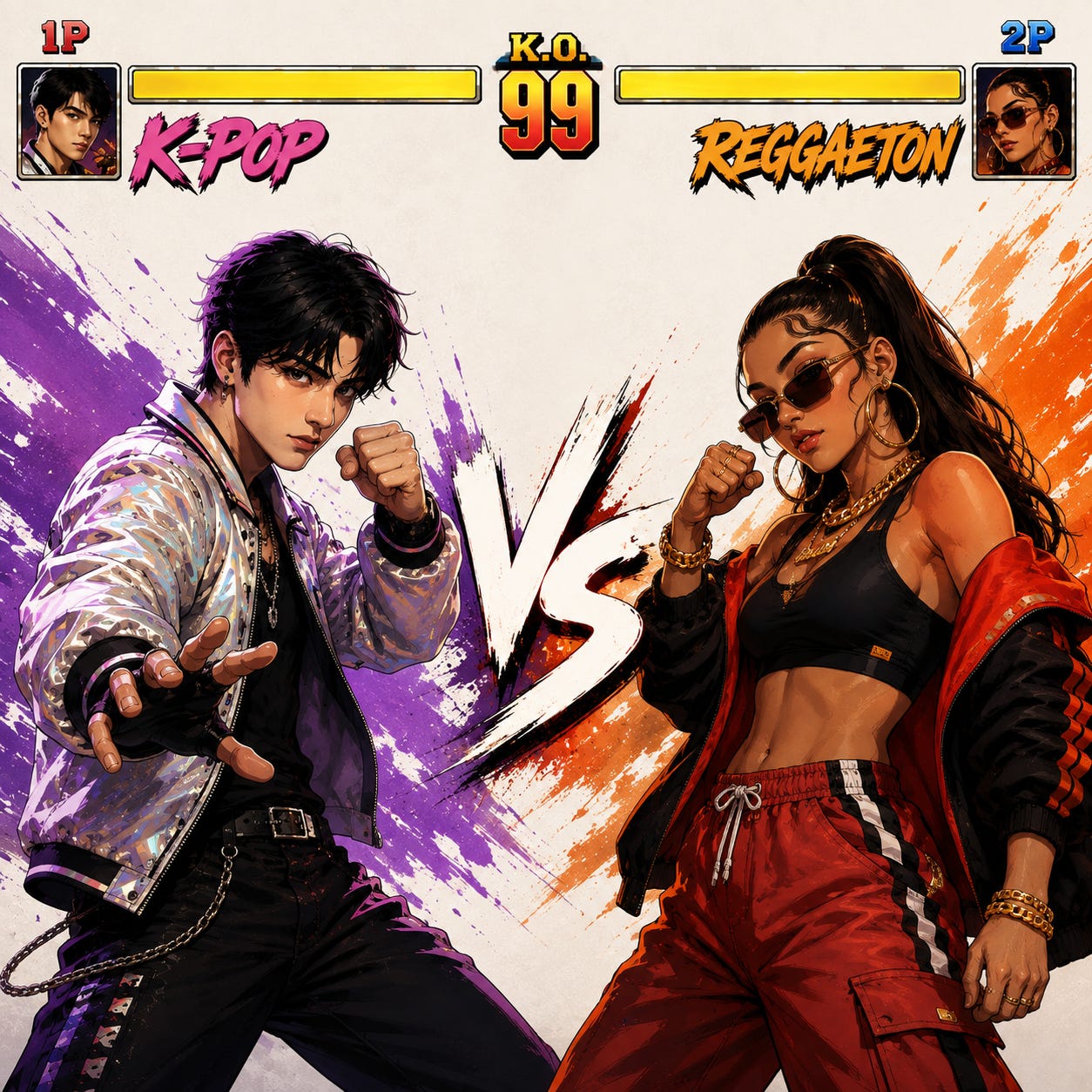
In the trenchant work of contemporary ethno-musicology that is Trolls World Tour, there’s one scene in particular that sticks out. As the main characters are transporting a magic lyre string from Pop Village to the Hard Rock kingdom, one of them is attacked by two teams of well-choreographed bounty hunters. The first team is from the K-pop gang (voiced collectively by Red Velvet), while the other is a hardened group of reggaetoneros led by a man/troll named Tresillo1 (who is, of course, voiced by J Balvin).2 Unsure which bounty hunting group will get to present their captive to the Hard Rock queen, the two naturally decide to settle the question with a dance-off.
The scene is goofy and fun, but it also works because it plays on a real-world impression that anyone with a passing familiarity with 21st-century music will recognize. K-pop and reggaeton are both genres originating from non-Western regions that have grown to become two of the most popular musical styles in the world, winning huge swaths of fans both inside and outside the Anglosphere. Both were influenced by local adaptations of hip hop refracted through their unique cultural setting, creating a sort of counter-symmetry that feeds well into a head-to-head battle narrative. Their places of origin are even located in roughly opposite corners of a standard world map. The rivalry basically writes itself.
But the true fight goes even deeper than that. Underneath these surface similarities, reggaeton and K-pop occupy opposing ends of the spectrum of ways that music styles can rise to global prominence. The first was championed by working-class communities that regularly clashed with implicit and explicit government censorship, while the other was quickly promoted by government and the corporate forces that positioned themselves to capitalize on its success. This contrast not only makes them mirror images of each other but, in many ways, avatars of the two visions of what music should be. In the same way music criticism in the early aughts was characterized by a discursive power struggle between Rockism and Poptimism, the broader music world in the 21st century may well be defined by a conceptual war between K-poppers and reggaetonistas.
A Tale Of Two Genres
The story of reggaeton has been told many times over. Here’s an abridged version: the genre’s roots were born in 80s-era Panama, when descendants of Jamaican immigrants that originally came to work on the Panama Canal began adapting reggae music by adding Spanish lyrics, creating the self-explanatory genre “reggae en español.” From there, this newly hispanicized version of reggae migrated to Puerto Rico, where it mixed with hip hop influences that New York-based Puerto Ricans were also importing back to the island. This syncretic Puerto Rican style was simply called “underground” until the term “reggaeton” was coined in the 90s.
Like hip hop, early reggaeton was mainly made by and for marginalized Black populations in the places where it came up. Also like hip hop, it was subsequently stigmatized by elements of high society in Puerto Rico, including the police and political class. The genre was directly targeted by anti-crime initiatives in the mid-90s, with police raiding record stores and caseríos (public housing projects) where reggaeton was popular. It wasn’t until much later, when the genre started incorporating more elements of Latin music, and when hits like “Gasolina” and especially “Despacito” rocketed it into the global consciousness, that reggaeton began to be associated with a broader Latin identity rather than Black communities within Latin America.
A classically rough-edged cut from reggaeton’s underground days
K-pop’s origins have some similarities with reggaeton, primarily through its debt to American hip hop. The influence of Western-style clubs that catered to U.S. military personnel stationed in South Korea is well-documented, particularly the Moon Night club that was popular with Black U.S. soldiers and consequently had hip hop on heavy rotation. Perhaps because it was a club, the Koreans that frequented Moon Night were as interested in the dancing behind the music as the music itself, laying the foundation for the tight links that modern K-pop has with choreography.
A number of future K-pop heavyweights, from Hyun Jin-Young to Yoo Young-Jin, honed their steps at Moon Night, and Seo Taiji reportedly drew inspiration from a performance he saw there. Seo would go on to lead the proto-K-pop group Seo Taiji and the Boys. In 1992, Seo’s group performed a hip hop-inspired song-and-dance routine on national Korean television in what’s now broadly considered to be Ground Zero for today’s K-pop sector. Fans loved it, and their album sold so well that specialized entertainment companies soon moved to capitalize on their success, adapting a talent training model pioneered by the “J-pop” industry in neighboring Japan.
Not the first K-pop performance, but one of the most influential (music starts at 1:50)
Coinciding with a loosening in Korean censorship rules, entertainment companies like SM, YG, and JYP stepped in to promote future stars of this youthful new area of the country’s music scene. However, while Japan’s pop industry was mostly directed at its larger domestic market, South Korea’s smaller size led its entertainment firms to quickly focus on exporting their talent abroad. The Korean government joined this party relatively fast, launching the “Hallyu Industry Support Development Plan” in 1998 to leverage Korea’s entertainment industry as an economic recovery tool following the Asian Financial Crisis.
This marks one of the biggest contrasts between K-pop and reggaeton. Unlike reggaeton, which was a largely localized movement, maligned by the mainstream for decades until its hits leaked out onto the world stage, K-pop was nurtured by commercial and government forces to be outward-facing almost from its inception. Korea’s government actively worked to popularize K-pop before the genre had escaped its national borders, while with reggaeton, government “support” primarily came after the genre had already proven itself overseas.
Art As Industrial Policy
Presenting these histories in isolation can give the false impression that K-pop and reggaeton’s distinct paths are two equally common ways for a genre to develop. In actuality, reggaeton’s bottoms-up approach is by far the more usual of the two routes. Pretty much every popular genre today, from major ones like jazz, house, and hip hop, to more niche examples like gqom, baile funk, and footwork, has a similar come-up story. All of them were born in marginalized communities, then grew in regional popularity for several years-to-decades while being maligned by mainstream powers-that-be until a hit single or hip label collab finally presented them to the world in a way that catapulted them to broader acceptance, if not massive popularity.
K-pop’s story, by contrast, is extremely rare. Outside of the obvious example of J-pop (and less cohesive analogies like Cantopop), the best corollaries from elsewhere are Motown in Detroit and maybe the professionalized pop groups overseen by the likes of Maurice Starr and Lou Pearlman in the second half of the 20th century. But neither of these latter U.S.-based examples are recognized as genres the way that K-pop is, and they remain relevant touchpoints only insofar as the definition of “K-pop” is broadened to include the commercial scaffolding that surrounds the music itself.
One of Maurice Starr’s creations
You could make the case that K-pop is actually just a commercial scaffolding masquerading as a genre, that it’s really more of a way to geo-tag a pre-existing type of mainstream music made in a specific part of the world — that it’s just ”pop” with a “K” in front of it. However, I think that sells the style short. Whatever its creators’ intentions, K-pop ultimately developed into its own distinct form of the music, characterized by a maximalism and bombastic sonic fingerprint that sets it apart on a continuum that runs from funk to hyperpop. Genres have been made out of less.3
Instead, I’d point to K-pop as one of the few examples of a music genre that developed in alignment with both corporate interests and government support. It’s fitting that this development path came out of South Korea, which, alongside other East Asian nations like Japan, Taiwan, and China, has reshaped both its own fortunes and the global economy with a state-sponsored manufacturing prowess that figured out how to mass-produce and export almost every consumer good imaginable. Why wouldn’t music be any different?
From many angles, this approach worked extremely well. Not necessarily for Japan and China, as the former focused on its domestic market and the latter decided to cut their pop industry off at the knees.4 But South Korea knocked it out of the park, creating a musical style that’s become so globally impactful that people are now talking about a hallyu, or “Korean wave.” In doing so, they bucked a longstanding development model that treated music genres as exogenous occurrences that grow epiphenomenally out of unstructured artistic communities. It turns out that, with the right combination of policy and capital, you can also engineer genres for export.
The first K-pop song to place on the Billboard Top 100, circa 2009
But even if the K-pop approach works, does it work better than the prevailing model? If we refocus on the K-pop vs. reggaeton framing and use popularity as a metric, the answer is probably “no.” Reggaeton’s streaming numbers are growing significantly faster than K-pop (at least in the U.S.),5 and while BTS is a massive band, Bad Bunny is arguably the biggest artist in the world. Of course, considering the small number of genres that developed with the K-pop approach, its hit rate is much higher than the reggaeton model. But for those that see music as fundamentally different from consumer products, something that can’t be designed on a factory floor, there’s still reason for optimism.
And in the end, that question is what this contest is about.
The Jump Ball For Music’s Soul
In the context of the above, the K-pop/reggaeton comparison could also be cast as a new variation of the Rockism/Poptimism debate that’s been burning in the background of music criticism for the last two decades. Broadly speaking, this debate has been concerned with the qualities that make music worthy of praise. Rockists have traditionally emphasized the importance of artistic integrity over commercial success, while Poptimists argue that a music’s inherent commercialism is irrelevant — or even laudatory — as long as the music is good.
Although it’s not often framed as such, I’d argue that this whole stand-off could be mapped onto a larger tension between two qualities that can signal value in music: Authenticity and Mastery. It’s generally good for artists to be authentic, to channel their own experiences and those of their communities into their music in a way that creates a true representation of those feelings and experiences. It’s also generally good for artists to be masterful, to present their music in a polished form that makes it clear they’ve put time and talent into mastering their craft.
These qualities are prioritized to different degrees depending on who you’re talking to, with Rockists tending to put a premium on Authenticity (think DIY punk groups with meager skills but a lot of attitude) and Poptimists tending to ally themselves with Mastery by highlighting the timeless beauty of a perfect pop song (think Addison Rae).6 While reggaeton isn’t rock, its roots in non-mainstream communities making music for the love of that music, authorities be damned, aligns well with the Rockist vision of how music should develop. By contrast, K-pop’s emphasis on tight hooks and flawless dance moves fits the Poptimist view that mastery of the form matters more than the environment in which that form is mastered.
One of the best-known groups to heavily weight the Attitude part of the equation
This is obviously an over-simplification. Many K-pop fans would take issue with the idea that K-pop artists aren’t Authentic, and it’s certainly not the case that reggaetoneros/as aren’t Masterful. This distinction is less about what these two genres actually are and more about the value systems that they (and their fans) prioritize. K-pop’s intertwined development with commercial resources naturally favors a celebration of what those resources have allowed its artists to achieve, while reggaeton is more likely to champion an artist’s lack of commercial affiliations as a way to signal how “real” they are. Reggaeton fans are actively discussing the implications of their music becoming commoditized; K-pop has been a commodity since practically forever.
It’s clear that both approaches, to put it bluntly, get results. K-pop has returned dividends to the country that supported it, elevating its heroes to bona fide megastars while establishing South Korea as a cultural juggernaut (and making a lot of people a lot of money in the process). Meanwhile, reggaeton has expanded the mainstream visibility of an entire continent while putting its own crown prince on one of the biggest stages in the world, where, in true reggaeton fashion, he staged what was essentially a protest concert against Puerto Rico’s imperial suzerain. Both outcomes are valid and important. Which one wins more hearts is as much a question of values as it is of tastes.
And the give-and-take between the two sides is playing out in real time as more countries, interested in replicating K-pop’s soft-power success, begin constructing their own pop genre ecosystems. The best example right now is the Philippines, whose homemade Pinoy pop (“P-pop”) style has started to prove it’s equally exportable, notching slots at Coachella and Lollapalooza this past year. Fittingly, the Philippines also has its own reggaeton-flavored foil to P-pop in budots, a Filipino house genre that rose from the streets of Davao City to viral dance floor domination. As a country, the Philippines is turning into a microcosm of the titanic K-pop vs. reggaeton clash that’s set to characterize global music trends for years to come.
Ambassadors of the coming Pinoy Wave
Taking It To The Floor
Coincidentally, if one were looking for a visual metaphor for a showdown between the dueling political economies of K-pop and reggaeton, a dance-off would be a pretty good option. Imagine, if you will, a hypothetical dance battle between two sides. The first side approaches dance as a technical skill, their steps mastered through diligent training and hours of practice. The second has dance built into the fabric of its culture, with children learning the steps naturally simply because their parents always played salsa whenever they clean the house. Which side do you think would win?
In Trolls World Tour, this dance battle ultimately ends in a draw, with both the K-pop and reggaeton hit squads expressing their respect for each other’s skills and agreeing to jointly deliver their captive to the Hard Rock queen. The real world feels like it’s on a similar path. K-pop and reggaeton are both continuing to grow, carving out their own fan bases and spheres of influences. As a clash of styles, they seem well-matched. But as a clash of values? That contest is still playing out.
Presumably named after the tresillo, a syncopated 3+3+2 rhythm that’s foundational to much Latin music. Seriously, this film is quite smart.
Other voice actors include Anderson .Paak, Mary J. Blige, Kelly Clarkson, George Clinton, Ozzy Osbourne, Justin Timberlake, Icona Pop, and Zooey Deschanel. Have I convinced you to watch this yet?
Also, before we put too much stock in nomenclature, let me remind everyone that “reggaeton” is technically just “reggae” with a “-ton” at the end.
Taiwan is an interesting case study that I haven’t dug into as much, but while Taiwanese pop has a notable presence in the East Asian pop ecosystem, it never gained the level of international dominance that K-pop’s achieved.
There are admittedly some confounding variables here, including the larger number of Spanish speakers than Korean speakers in the U.S. But as a neutral battleground for popularity, the U.S. is about as good an option as anywhere else.
There are, of course, corners of the rock world that also emphasize the importance of Mastery (math rock, etc.) But technicality fetishes in rock music tend to be more peripheral to the genre’s overall appeal, and messiness is more accepted as an aesthetic principle in rock than it is in pop.